No quasi-philosophical writing rants today; instead,
this is my chance to hear from all you people. The link at the end of this post
will take you to a ridiculously brief survey so you can give me your feedback
on my blog and my writing in general—and don’t worry, I throw some stuff in
there to keep it interesting! So, if you could spare five minutes, the
interrogation awaits…
Thursday, June 15, 2017
Thursday, June 1, 2017
Get Igly
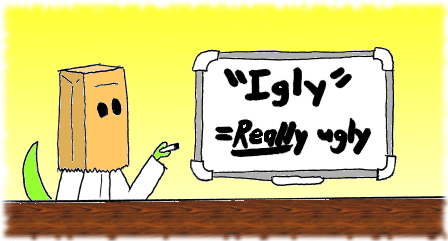
“Why have I not yet written about ugly people in
literature?”—that’s the thought that occurred to me when I looked in the mirror
this morning. Ha ha. But anyway, recent writers (maybe even you) have been incorporating less-than-glamorous characters into their works. Let's find out why...
First of all, the title of this reflection utilizes the
word “igly”. No matter what my spell-check says, that’s not a typo; it’s apparently
a very elusive and unused word. According to Bart King’s The Big Book of Boy Stuff (one of my many hallowed texts), “igly”
means “Really, really ugly.” On the
other hand, the online Urban Dictionary defines the word slightly differently,
saying that it means “The quality of being ugly and cute at the same time.”
Every other dictionary denies the word exists; this obviously indicates that
the word is an underrepresented minority, and therefore needs to be given our
full appreciation and support! But social justice aside, the slightly differing
definitions actually don’t worry me—both of them will serve my purposes here.
More on that in a minute.
So, on to literature. Fortunately the literary spectrum
is not wholly populated by beautiful people, and thank goodness; if the main
characters were always gorgeous, the rest of us non-pop-stars would probably
find them less relatable. Take the comic book Valerian, for instance. In my efforts to broaden my sci-fi
database, I checked out a copy from my local library and burned through it in a
day. While I was more than impressed with the artful world-building (I can only
pray the upcoming CGI cinematic adaptation will do it justice), it seemed the
sworn duty of every single character
to mention how pretty Laureline was. It became my litmus test for the moral
bend for each individual; if they noticed how hot Valerian’s sidekick was—even
if the observers were of a wholly different species—they were on the side of
the good. It got exhausting; Yes, she’s
pretty, get over it was my reaction less than halfway through the
adventure. Therefore, it’s not surprising that a more relatable and less
picturesque protagonist has emerged over the years, acting as a counterpoint to
the familiar “Beauty Culture”. However, in its popularity, it has become a
separate trend in itself, and as with all trends, it should be analyzed. Why do
we use it—and if you are also a writer, why do you use it?
However, if I analyze all of ugliness, it would take way too long. Plus I’d have to study
more things along the lines of stereotypes and popularity and cultural norms of
beauty, and that can get pretty boring after extended exposure. For both of our
sakes, then, I’m limiting my analysis to this category: Characters Who Do Not
See Themselves as Appealing.
It’s still a large list.
You know what I’m talking about. Let’s have a look at a
few: Quasimodo, Frankenstein’s Monster, Tris in Divergent, Cassie in 5th
Wave…I think the list extends to Katniss in Hunger Games and Cia in The
Testing, but I can’t remember if that’s so (and the books aren’t within a
3-foot radius of my person). Someone will have to tell me if it extends to
Bella in Twilight too; I don’t know
if she thinks she’s ordinary, but it’s likely. The point is, much
fiction—including recent fiction—has a main character who does not think of
him/herself as “the fairest of them all”. You might even have such a character;
if you’re a writer nowadays, you can’t get by without one. But why is that
character like that? What is the reason for their additional unsightliness? As
an author, you can’t just say that you’re fighting the Beauty Culture. Unless
your character is ugly because they’re
consciously trying to fight the Beauty Culture, that’s not the reason you did
it. So find one of your MCs (or find a book with such a protagonist) and let’s
see how they compare to some of the reasons why a character is ugly.
1)
The
protagonist/character is trying to fight the Beauty Culture. No, I’m not contradicting
what I said earlier. It can happen;
for instance, when a character purposefully does not adhere to the culture’s
norms for beauty, especially in the way they dress. An example I can think of
is Piper from Rick Riordan’s Heroes of
Olympus series—even though she’s (MINOR SPOILER) a child of Aphrodite, she
rebels against the typical self-obsessive preening of her cabinmates. This does
accidentally make her more beautiful/approachable in the eyes of her love
interest, of course…
2)
The
protagonist/character is ugly, and knows him/herself to be so. Think of the
extreme cases, like Frankenstein and Quasimodo, or the Beast in Beauty and the Beast. There’s also that
movie coming out in November, Wonder,
about a boy with facial scarring who attends public school for the first time.
Here, the purpose of the deformities is the clearest and strongest; the
ugliness is what separates the character from the rest of the world. They’re
seen as “igly” in the sense of really ugly.
For the sake of exploring a unique individual’s isolation and/or people’s
perception of the appealing, it’s an excellent element. If the character wholly
obsesses on it, though, it indicates
vanity—which will come up again later. As an example, Hester Shaw in the Philip
Reeve’s Mortal Engines series has a
massive scar across her face—and her focus on it builds a wall between her and
the other MC, Tom Natsworthy. The lack of progress in dismantling the wall was
what put me off reading more than the first two books of the quartet; Hester’s
character never really moved beyond how ugly she thought she was.
This kind of focus is not the worst issue, though, for here comes
the biggest troublemaker of them all…
3)
The
protagonist/character is NOT ugly, but believes him/herself to be so. This
is arguably the most popular version that is out there in literature today. At
worst, the character is “igly” in the sense of cute and ugly. Or the character could be plain. But the most common
case is that the character is actually a looker. In 5th Wave, I can’t take Cassie’s lamentations seriously
when she’s being portrayed by Chloe Moretz and a love triangle is being formed
around her. At any rate, this self-perception is an illusion generated by the
character him/herself, and as is the case with any falsehood, the creator can
either believe or disbelieve it.
If the attractive character does believe that he/she is ugly or plain, it’s a sign of that
superficial vanity that was brought up earlier. The protagonist looks fine, but
looks into the magic mirror while lamenting that she’s not the fairest in the
land…usually because he/she is not attracting the undivided attention of
his/her secret crush. On the one hand, it’s often a good thing when character
does not believe that he’s God’s ultimate gob of eye candy—whole separate
problem there. On the other hand, though, it deals a serious blow to the
character himself (I’m tired of writing “him/herself”) if the person is
convinced of his irredeemable imperfection. It results in, one, an unnecessary
pessimistic timidity on the part of the protagonist; and two, an obsession on
the protagonist’s part that he is not achieving some artificial
standard—compromising the character himself as he strives for a self-centered
and unrealistic goal. He’s focused on the outside, the most misleading factor;
and when that’s the most prominent, it eats away the rest of him.
If the attractive character doesn’t wholly believe that he’s ugly/plain but promotes the idea anyway,
though, it means that he’s…how do I put this?…fishing for compliments. I do
this all the time; look at my opening line of this essay if you don’t believe
me. Now granted, some characters need
some self-affirmation, for instance, when the protagonist has been told—in a
Cinderella-esque fashion—that they are nothing special. But see if this sounds
familiar:
“I’m not beautiful,”
she said.
“But you are
beautiful!” he replied, gazing into her eyes.
When the protagonist has had a regular upbringing, this kind
of questioning is manipulative. It steers the friend/significant other into
doing exactly what he’s supposed to do, that is, tell her what she wants to
hear. What was he supposed to say?
“I’m not beautiful,”
she said.
“And boy, you’re not
kidding,” he replied, gazing into her eyes.
Look back to Version One of this scene; even though she hears
what she wants, the girl can’t fully believe that the boy is telling the truth.
Don’t think so? Odds are the plot complication of the narrative will, at some
point, include the girl thinking he
doesn’t think I’m THAT beautiful. Then, if she doesn’t again hear what she wants, she runs the risk of actually believing
she’s nothing special…and I’ve already talked about how shallow that is.
Note: I’m not saying that I hate writers who write about the
beautiful-but-blind. I just don’t like the ones who reward their protagonists
for being shallow. You’d better handle this well, that’s all I’m saying. I’ve
ranted long enough about 5th
Wave.
In conclusion, I invite you to look closer at the ugly
characters—and your ugly self—to see how the imperfections shape their
respective subjects. A well-balanced person neither obsesses over their
imperfections nor denies that they exist. Rather, the balance is in the middle;
they fight against their problems, but don’t let them define who they are.
In my defense, this reflection wasn’t supposed to be
this long. I thank you and your igly face for hanging in there.
Tuesday, May 16, 2017
Imperfect Perfection
So…Guardians of
the Galaxy Vol. 2 has been out for a little while; if I am wrong in
assuming that you have seen it, then it may be in your best interests to stop
reading now. Well, actually you can keep going if you’d like—what I’ll be
expounding upon today is not really a movie-spoiler, and I can’t afford to lose
any readership I may have.
Here is the section in question: the movie begins with
the wonderfully scrappy Guardians of the Galaxy squaring off with an ugly,
tough space monster from another dimension. It should be no surprise to tell
you that the Guardians emerge triumphant (otherwise there wouldn’t be much
movie left); after their victory, they collect their bounty from the beings who
hired them for the job in the first place. They are the Sovereign, a humanoid
yet completely golden race of very, very proud beings. The reason for their
pride comes from the fact that, through their self-applied technology, they
have essentially perfected their species. They make no small point of this fact
to the Guardians, and certainly from their perspective they have a point—the
mismatched misfit band of heroes can hardly be called a stable, reliable
foundation in comparison to their contractors.
Speaking of instability, when Rocket…no spoilers…“offends” the Sovereign,
shall we say, the perfect race turns on their former hired hitmen and send an
entire fleet of podlike starfighters to take them down. I’ll give you three
guesses as to who gets the better in the fight—just in case you accidentally and
wrongly guess “The Sovereign” twice for some reason.
There is a sci-fi point that I would like to make from
this, which will then evolve into a writing point. Just stay with me here.
The most dealt-with topic in science fiction is the idea
of perfection, especially through the means of technology. This is no large
claim, since any advancement in technology can be called a movement towards
perfection—that much is plain. Frankenstein in Frankenstein is looking to improve people by curing death. In The Giver by Lois Lowry, the…um,
Governing Structure Whose Name I Forget is trying to maintain a perfect
homogenous society. The Cybermen of Doctor
Who want to unify and cure humanity of all ills through assimilation—“You
will be assimilated” is literally their battle cry. Some sci-fi writers, such
as the notable H.G. Wells, were and are in favor of this technological
perfection; science seems a pliable path to this end (yes, I said pliable—the
path can be manipulated by man).
But, and this is kind of an informed yet made-up
estimate, 95% of science fiction comes out against this idea. The Sovereign,
Frankenstein, G.S.W.N.I.F. (I’m not good at remembering names, OK? I had to Google Lois Lowry earlier), Cybermen,
Borgs, Ultron, et cetera ad infinitum…all of these characters seek perfection
to the exclusion of all else, to the ignorance of the price. To Rocket Raccoon,
the Sovereign’s problem is obvious; they’re a bunch of (ahem) “d*****bags”.
They’ve lost relatability and humility, and, as the following space battle
illustrates, they’re not that perfect anyway. Cybermen go down a dime a dozen
before the Doctor. And as long as we’re talking about doctors, Frankenstein’s
story is a definite tragedy, as his backfiring experiment will make a monster
out of both dead human parts and also the doctor himself.
Science fiction, if anything, is an experiment to test
the miracle technology before it has been developed—often revealing that it’s
not quite the miracle we think it is. Ironically, the “imperfect” is what
ultimately destroys the seeming perfection; the dysfunctional Guardians of the
Galaxy prevail over the Sovereign. The nonstandard Enterprise prevails over the Borgs. The bizarre Doctor prevails
over the Cybermen. In all these cases, one may note, the bad guys never see it coming. Blinded by their own perfect
image, they fall easy prey to the unpredictable shenanigans of the heroes.
Homogeny is blasted by complementary variety. The Science Fiction Point I’m
trying to make is this: if anyone calls me “perfect”, I’ll consider that both
an inaccuracy and a gross insult.
Which leads me to the Writing Point.
All you writers out there—we can agree that the harshest
piece of criticism your work can receive sounds like this: “The main character
was too perfect.” I’ve had this lobbed at me more than a few times in my career
(but once I was able to convince the reader that he was being too understanding
of the MC—different story though). Their problem with the hero is that he/she
is “unrealistic”; the image of the imperfect hero is deeply ingrained into our
consciousness, and for good reason. It’s not an insult to say that the villain is
perfect (leaving aside horribly imperfect villains for a moment). In fact, a
perfect-seeming bad guy can open up all kinds of interesting questions into the
nature of true perfection itself. But a flawed hero is what every reader wants
to read and relate towards; the plot of the story often brings the character to
a realization of his flaw and an action to repair himself. How additionally
ironic that is a surer way to better oneself than the villain’s technological
methods.
That was an awful lot for a reflection based on a
fifteen-minute segment of a popular movie. If this blog is getting too
amateurishly philosophical, my apologies; maybe I’ll go crazy again in time for
June.
Monday, May 1, 2017
Finals Blues
It’s finals week at my college. If you were honestly
expecting a blog post to come out of this time, you’re crazier than I am.
I do have a bunch of other posts to peruse while you
wait, though, so if you need to kill some time I’d start there.
Sunday, April 16, 2017
Robots, Intelligence, and Overwatch
Happy Easter, readers! And I’m sorry, but I’m about to
wax philosophical again. The topic today is something that touches close to my
home and heart, though; specifically, science fiction video games. Even more
specifically, Blizzard’s whirlwind-success first-person-shooter game Overwatch.
I do not have this game, and that’s not really a
complaint. The game has something that intrigues me more on an authorial level
rather than a competitive one. A game really sells itself to me if it has two
important features: one, sci-fi elements (of course), and two, a decent
storyline behind it. A lot of my favorite electronic pastimes have these
elements—Portal/Portal 2, Invisible Inc.,
Subnautica—and Overwatch has a
significant amount of story included with the action. Just breeze through the Media page on their
website; there are enough comics, trailers, and video clips to compose a novel,
albeit with a slightly lightweight and fragmented narrative. The story’s
premise is not complicated. During a humans-versus-robots (robots hereafter
referred to as “omnics”) war, a team of random, superhero-esque fighters known
as “Overwatch” rose up to bring about peace between the people and the
machines. Then Overwatch was disbanded; I think it was because of collateral
damage or disregard-of-protocol or something…but anyway, now the team has been
re-formed. A terrorist group by the callsign “Talon” has arisen, seeking to
destroy both the world’s guardians and the harmony of the futuristic society.
That’s it in a low-resolution nutshell.
I spend an inordinate amount of time deciding whose side
I would be on if I were an inhabitant—or active combatant—in this world. No
matter how cool they may appear, I do not favor Talon; they’re your pretty
basic kind of evil.
However…I’d hesitate to sign the Overwatch contract too.
Why? Well, there’s a little hiccup in this future
society that I cannot overlook. The peace of this society is founded on the
unity between humans and robotic omnics, which sounded pretty nice—until I ran
across the full implication. It seems to be a promotion of an extreme unity; I’m not just talking
about unity of purpose, being on the same side of peace and justice and all
that. No, the sympathetic characters stress an actual unity, the idea that there is no difference here between
human and machine, that they are “all one within the iris” (that quote can be
found here).
Sorry to be Sir Stormcloud Sonnek over here, but…um, no.
That’s not right. My inner G.K. Chesterton-fueled reason will not accept that
dogma, and now I hope I can adequately explain why. Hold on to something; it’s
about to get complicated in here.
To begin: I’m looking over my room right now. I see a
lamp. I see a wristwatch on my wrist. I see a laptop—I’m typing on it right
now. These useful, working items did not come into being on their own; they
were designed and created by humans (you may say they were created by other
machines, but consider this; who created those machines? And the machines
before them…?). So first of all, humans hold the priority as creators of the
mechanical. Next, it’s true that my wristwatch has more “intelligence” than the
lamp—this timepiece knows all the
world’s time zones, people—and my laptop definitely
has more intelligence than the watch. Some computers, like Cleverbot, can
imitate a kind of real intelligence, carrying on a conversation or running a
complex theorem. The omnics of Overwatch have even more intelligence than this;
they evidently have achieved self-awareness, a personal will, consciences, and
even deeper transcendence. But are they the same as humans? No. Still machines.
The level of intelligence does not determine what a thing is at its essence. A
mentally handicapped human is still a human. An artificial intelligence is
still a computer. So, on a scientific level, omnics are not the same as humans.
That should be fairly obvious (and genuinely not racist).
But what about on the level of dignity? One of the
backstories in Overwatch is that
omnics were, and somewhat still are, treated as slaves for labor or soldiers
for war, even though they still have intellects and wills. Should they have
equal dignity as humans? My answer is…not enough data. See, a machine is
essentially a puppet to its programming; as any computer science major will
tell you, a computer says whatever the programmer tells it to say. The human
provides the input, the machine generates output. If it’s an incredibly complex
program, then it might be able to imitate intelligence, and if it’s even more
sophisticated it may even imitate the will; but even so, an imitation is not as
good as the genuine intellect and will that a human possesses. However, the Overwatch devotee—or person who read the
last pargraph, I suppose—will argue that the omnics have self-awareness and
self-transcendence, operating their own minds as people do. My answer is…really?
From our side of the video game, we can’t be sure. The omnics could be running
on hyper-hyper-hyper-advanced software, for all we geniuses know. But what if
they really do have a genuine, self-contained intellect and will—and maybe even
emotions? Then sh*t gets complicated.
Humans and omnics still won’t be the same, but those machines will have much closer dignity to us than my lamp
does to me. Again, not the same, but with a closer dignity—possibly equal, if
they somehow have acquired human souls.
Which brings me to my conclusion—how these omnics should
ideally be treated. My proposal is thus: in this aspect, Overwatch has the
right idea. Treat them as you would a human. Here is my example: suppose I
lined up a bunch of objects and started to punch them. Both you and the
gathering masses would be fine with me pulverizing the pillow. You’d be OK with
me creaming a clock. But you might start to get nervous if I kicked the
mannequin. There would be some alarm if I smashed a statue or destroyed a
recording of a person speaking. The point is, the closer the thing is to a
human, the more dignity the thing has by association. Omnics? In both the
worst- and the best-case scenarios, they bear a really close resemblance to the human, and therefore have an
intrinsic dignity that is close to our own. Slavery is out. Exploitation is not
good. If it can act like a human, then it’s good for the omnic—and for the human—if the machine is treated with
respect. Leave the manual labor to the actual machines.
Phew. As you can see, that would be an awful lot to cram
into a cartoon, and I didn’t even cover the idea of the Singularity (a person’s
mind being successfully transplanted into a machine). I know that Overwatch is trying to promote unity
both in its world and ours, but it might go a little overboard in its
hyper-unified philosophy. That’s all. Good for me I was born in this century;
otherwise Overwatch would probably have to shoot me in the face for my constant
and unintelligible pontificating.
Now go celebrate Easter or something.
Saturday, April 1, 2017
April Newsletter With Many Links
Another rather busy half-month here. Even though college stuff is in full gear, there’s been a good bit of action from my whole writing department. To begin…
1)
Still
getting stories rejected.
That’s pretty standard for everybody, but I don’t seem
to bring it up much. Now you know that, yes, I am a normal writer in that
regard. But, since these publishers never give me feedback, I just assume that
they were being honest about their perennial deluge of submissions—so I can
keep on writing the same way!
You’re not cheering.
Okay, moving on. Speaking of feedback…
2)
Stormlock: Activation needs reviewers on
Inkitt
Some of you writers out there may be already be familiar
with Inkitt,
but just in case, here’s my thirty-second description: Inkitt is basically a
forum where writers can share their stories (automatically copyrighted,
thankfully) so other writers can read them and leave feedback. If the story is
popular enough, Inkitt may even consider helping you pitch the book to various
publishers, or might even ask if they can publish it themselves. I’m not
necessarily looking for publication here, but I have posted a book there that
needs some support.
The book? It’s my first installment of the Stormlock series. I’ve already got some
people interested, so if you are also one of these people, act fast; there are
only 100 free copies available, and they’re starting to get away.
Speaking of publication…
3)
New
short story published!
Go take a look at my Published Works page when you get the
chance; my college’s annual arts magazine came out a little earlier this year,
and my story “The Longest Three Days” was included. And got me a second fiction award. Didn’t
think that was actually possible, but I’m not complaining. If anything, people
are telling me to shut up about winning the award again.
Speaking of me shutting up…
4)
Another
blog for you to read
In my last post, I touted a blog by a writer friend of mine.
Another one of my writer friends might have noticed this, so before he comes to
firebomb my sock drawer, you should also have a look at the blog Maximum Effect. It a barrel of fun. The stories he has there, particularly the vivid tales of his comically harrowing childhood,
have struck a tone with quite a few readers—myself included.
Speaking of the comically harrowing…
5)
A
reflection on writing
…would have been here, but I put it somewhere else. So
here’s another reason to visit Inkitt; in their Writing and Editing Group, I offered a brief
meditation on the role of comedy in improving both form and content of a
written work. It’s a very brief meditation—since it is, after all, a group
forum post. You might have to scroll down until you find my name, though. The profile
picture should be familiar.
Now if you’ll excuse me, I need to go write some stuff
for college. The joys of being an English major…
Sunday, March 12, 2017
March Newsletter With Many Links
There is a reason why this post is out slightly before
the midpoint of the month. The reason is directly related to the first item of
this newsletter:
1)
New
Short Story Published By Perihelion
If you’re a new reader, extending your curiosity beyond
that story and onto its author, that is myself, welcome! I hope you enjoyed “Natural
Eyes”—it was one of my favorite stories to conceptualize and construct. I’ve
got some more stuff under “Published Works” if you’re interested; a lot of those stories are shorter (and
often stranger) than the one you just read, so breezing through my online
anthology there shouldn’t take too long. Keep an eye out for more stories—and books,
hopefully—as my writing progresses!
If you’re one of my loyal blog readers who hasn’t read
the story as of yet…you need to get caught up on some homework. My latest story
should be online now at Perihelion. That link will take you
to the publication’s website, but you might have to poke around a bit to find the
actual story; as I’m writing this, Perihelion’s
latest update hasn’t been published yet. Rest assured, there will be a direct
link on the “Works Published” page very soon.
Alright, next item of business…
2)
Fellow
Writer’s Blog
A writer with whom I am acquainted has a blog of her
own, and I have shamefully neglected to mention its existence here until…now. Quills and Needles is produced by a
mysterious writer who never really mentions herself by name—so I shall refrain
from doing so here—and, in the blog, reviews books, writing things, and facets
of life in general, with bouts of blogger’s block. Basically what I do here, only better.
How well do I know this writer? She was one of the
contributors in the “Story of a Writing Prompt”; I forget if she’s the top hat person or the
$200,000 check person.
3)
All
Hail The Glow Cloud
So it’s Lent, and I’ve decided that I need a break from
time-and-laptop-burning computer games. On a recommendation from my girlfriend,
I’ve found something to listen to while I invent new ways of wasting time: the
YouTube series “Welcome to Nightvale”. What is “Welcome to Nightvale” exactly? Best I can
describe it, it’s a hopefully fictional radio channel for the bizarre little
town of Nightvale, reporting news and other mystical inexplicable happenings in
a sonorous voice. The stories it communicates are even stranger than the ideas
that I invent, or even the fact that I have a girlfriend. I highly recommend
checking it out, but for your own sake, you won’t want to be in a dark and
creepy place when you listen to it. Barring interdimensional malfunctions, the
episodes take about 20 minutes apiece.
4)
A
Writing Reflection
One of the college classes that I’m taking this year is
a course in creative writing technique; that writer friend from item #2 can
probably vouch for me. In a reading for that class, namely a section of the
book Method and Madness by Alice
LaPlante, the author advises that…
“Most of the time, you
should use the word ‘said.’ If you can, drop it. But don’t worry about it being
repetitive, as it is so much a part of fiction that it is virtually invisible.
Do not—repeat, do not—feel you need to use substitutes like…[list of substitute
words]”
By my reckoning, this is horrible advice. I’ve read a
few stories where the only quotational indicator (aside from the quotation
marks) was the word “said.” As a result, the scene feels pretty dry, like the
speaker’s expression and posture is hidden by a whiteboard with some un-nuanced
monologue upon it. Like a separate character in its own right, I like to know
what that quotation is trying to do. Is it an idle mention? A pointed remark? Does
it cut through the air? Is a variant of “said” even required—does the speaker’s
posture say it all (“Bert leaned up against the truck, snorting a cloud of
vapor. “Well, I think blah blah blah…”)?
Before you all start pointing out how many times I use
the word said in my own stories—right
now I’m too scared to go look for myself—I don’t mean to condemn all uses of “said.” The character had
better have a lot of color around him before you even consider using that word,
though; a decent amount of description, and “said” may even make the transition
to dialogue easier. If your story sounds like “Bert-said-and-then-Bob-said-and-then-Bert-said-and-then-Utnapishtim-said…”,
I’m just saying, you might need to demonstrate what sets their tones apart.
Tune in next time, when I shall have to come to the
defense of adverbs in writing. Carefully, tastefully, tactically, usefully, and
brilliantly placed, of course.
Subscribe to:
Posts (Atom)